
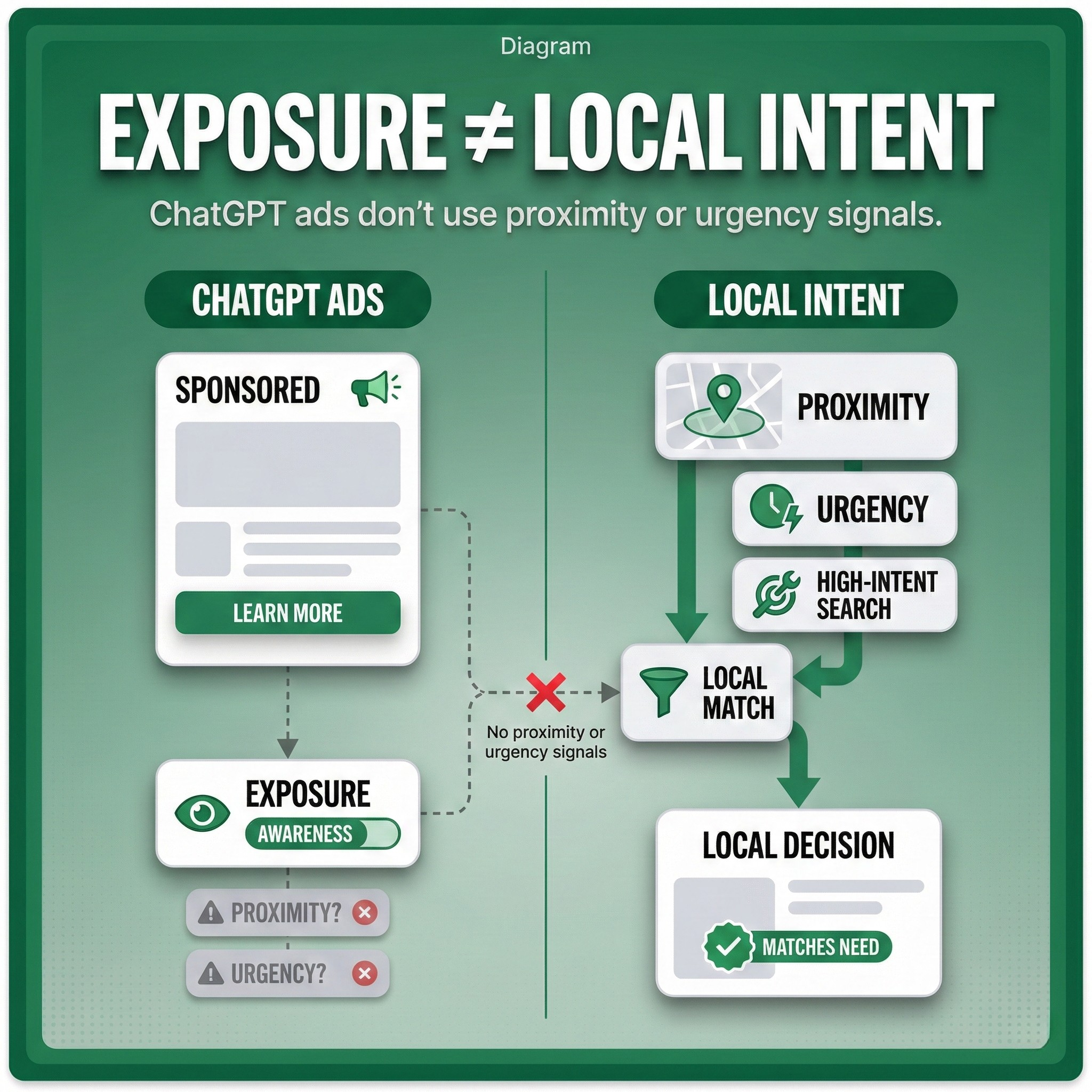
Do ChatGPT ads help local businesses? ChatGPT ads generally do not help local businesses acquire customers. They do not target geographic intent, proximity, or urgency, and they do not influence AI answers, trust signals, or local search rankings.
Do Chat GPT ads help local businesses? Why local businesses are asking this now
Local businesses operate on intent, not awareness.
A plumber, dentist, contractor, or legal firm does not win by being broadly visible. They win by being discovered at the exact moment someone nearby needs help.
When ChatGPT announced advertising, many local business owners assumed a familiar model: pay for visibility, generate leads. That assumption reflects how search and social ads work. It does not reflect how ChatGPT ads are designed.
To understand why, you have to look at how local demand actually forms.
How local demand really works
Local demand is driven by three core signals.
Geography
City, suburb, service area, or jurisdiction determines relevance. If the business cannot serve the location, the impression has no value.
Urgency
Local searches are time-sensitive. Phrases like “near me,” “open now,” and “today” dominate service queries.
Trust under constraint
Users need fast confidence. They are not comparing brands. They are choosing who feels reliable enough to call right now.
BrightLocal research shows:
- Most consumers use search engines to find local services
- Most contact a business within 24 hours of a local search
- Location modifiers dominate local service queries
ChatGPT ads do not operate on these signals.
What ChatGPT ads are optimised for instead
ChatGPT ads are built for:
- Broad exposure
- General context
- Non-urgent discovery
- High-attention environments
They are not designed for:
- Local proximity
- Service availability
- Jurisdictional relevance
- Immediate contact
OpenAI has confirmed that ads are separated from responses and are not targeted using chat history. There is no evidence of intent-driven or proximity-based delivery comparable to local search or maps.
Why this mismatch matters
Local businesses depend on precision.
A restaurant in one city gains little from impressions elsewhere. A lawyer licensed in one jurisdiction cannot convert interest from another. A tradesperson benefits from speed and location alignment, not brand recall.
ChatGPT ads provide reach without precision.
That mismatch explains why local businesses often see impressions without outcomes.
Local intent versus AI advertising
Local businesses require geographic targeting, proximity relevance, urgent intent capture, and trust signalling. ChatGPT ads do not prioritise these factors.
They offer exposure, not alignment.
As a result, ads may generate awareness without calls, bookings, or visits.
The misconception about AI mentions
Some local businesses believe that advertising on ChatGPT increases the chance of being mentioned organically in AI answers.
There is no evidence this happens.
AI systems deliberately avoid allowing paid influence to shape answers. OpenAI has stated that ads do not affect response generation. This mirrors the long-standing separation between ads and organic results in search engines.
Mentions are earned through clarity, consistency, and corroboration, not spend.
When ChatGPT ads might make limited sense locally
There are narrow scenarios where testing ChatGPT ads could be reasonable.
Destination-based businesses
Tourism operators, attractions, or experiences that benefit from inspiration-stage discovery may see some brand lift.
Multi-location brands
Businesses operating across many cities may use ChatGPT ads for broad awareness, not lead generation.
Even in these cases, expectations must remain conservative.
Why local SEO and AI visibility matter more
For local businesses, the fundamentals have not changed.
What drives results is:
- Clear service areas
- Accurate business information
- Strong local signals
- Consistent entity data
- Reviews and trust indicators
These signals support:
- Local search rankings
- Map visibility
- AI answer accuracy
- High-intent discovery
Advertising does not replace them.
How Valpo Agency approaches local visibility in AI contexts
Valpo Agency does not recommend ChatGPT ads as a default strategy for local businesses.
The focus stays on:
- Making local entities unambiguous
- Ensuring geographic and jurisdictional clarity
- Structuring information so AI systems can interpret it accurately
- Aligning search visibility and AI visibility rather than chasing exposure
This protects local businesses from spending on channels that do not match how demand actually forms.
The guiding principle is alignment.
Local visibility must match local intent.
Frequently asked questions– Do ChatGPT Ads Help Local Businesses?
Can ChatGPT ads generate leads for local businesses?
In most cases, no. They lack proximity and urgency targeting.
Are ChatGPT ads cheaper than local search ads?
Cost is not the deciding factor. Intent alignment is.
Should local businesses ignore ChatGPT entirely?
No. The focus should be on being accurately represented in AI answers, not on advertising.