
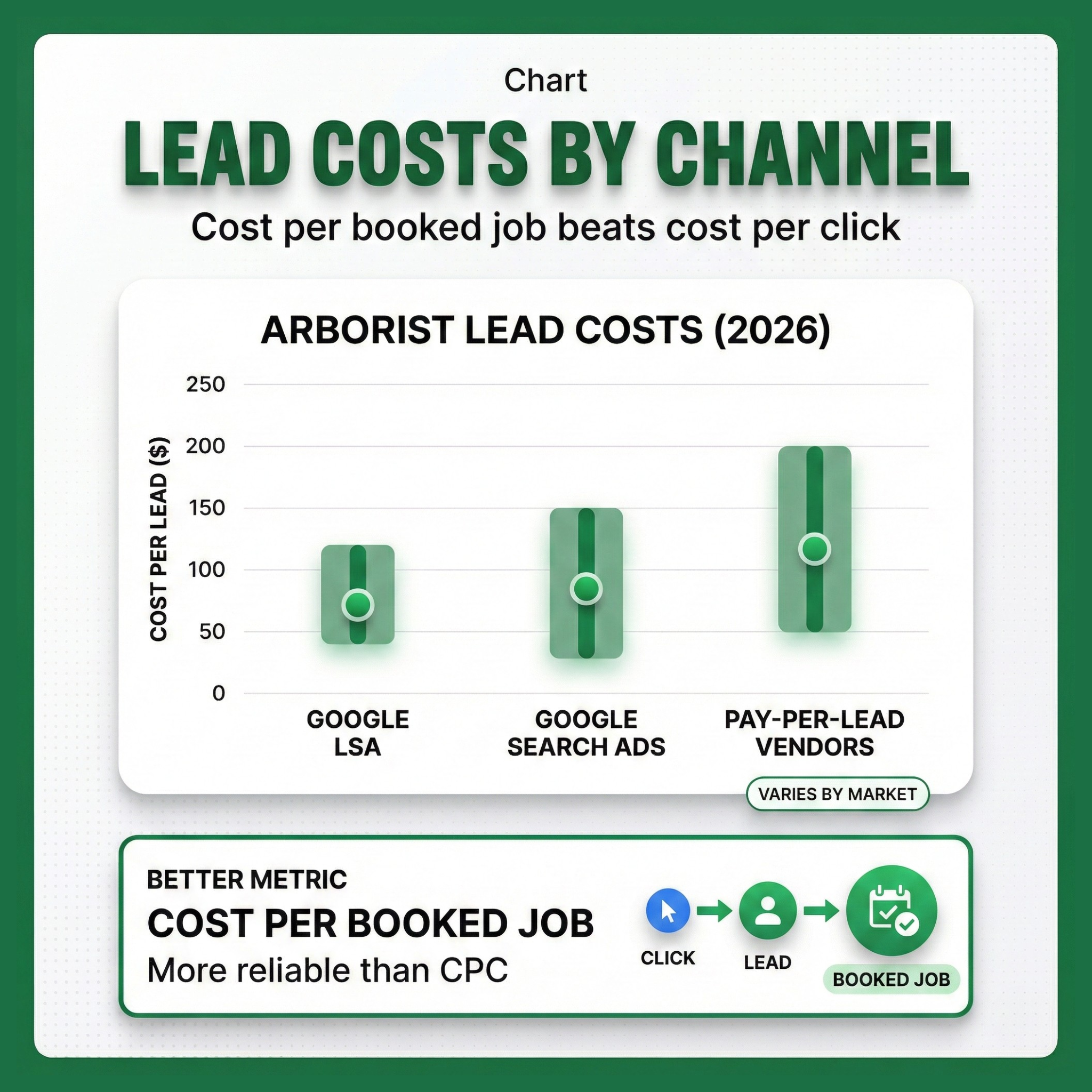
In 2026, the cost of lead generation services for arborists, may vary from channel to channel. Google Local Services Ads typically price leads per valid contact and often benchmarks in the tens of dollars per lead, while Google Search Ads commonly benchmark closer to about $70 per lead across industries, with home services trending upward, meaning arborists should plan ranges by channel and manage toward cost per booked job, not cost per click.
Table of contents
- Why arborist lead costs swing so much
- The 3 most common lead-gen models in 2026
- Google Local Services Ads costs in 2026
- Google Search Ads costs in 2026
- Pay-per-lead vendors: what the market pricing looks like
- What “lead gen services” fees usually include
- The only formula that prevents overspending
- How to lower CPL without chasing low-quality leads
- What to track weekly
- FAQs
1. Why arborist lead costs swing so much
Cost of lead generation services for arborists in 2026 – Tree removal leads near me, emergency tree removal leads, Google Business Profile tree removal, local SEO for tree removal, tree removal marketing, tree removal Google Ads, tree removal landing page, tree removal website conversion, contractor lead tracking- Arborist work sits in a tough category: it’s local, urgent, and high-stakes. That combination increases competition and drives up lead prices, especially for removals and emergency calls.
Your cost per lead (CPL) is shaped by:
- Market competition (how many companies bid in the same radius)
- Job type (removal and emergency usually cost more than trimming)
- Seasonality (storm periods spike demand and competition)
- Conversion rate (how well your page and call handling turn leads into booked jobs)
This is why averages are useful for planning, but dangerous for decision-making.
2. The 3 most common lead-gen models in 2026
The cost of lead generation services in 2026, is a big topic, and most arborist lead generation falls into one of these models:
- Pay-per-lead ads (Google Local Services Ads)
You pay per valid lead you receive. Google states you’re charged for each valid lead, and lead prices vary by location, job type, lead type, and bidding mode. - Pay-per-click ads (Google Search Ads)
You pay for clicks, and your CPL depends heavily on conversion rate and tracking. WordStream reports the overall average cost per lead in Google Ads in 2025 was $70.11. - Pay-per-lead vendors (marketplaces and lead sellers)
You buy leads directly, often priced differently for shared vs exclusive and form vs call leads.
3. Google Local Services Ads costs in 2026
How LSAs are charged
Google’s Local Services documentation is clear: you’re charged for each valid lead you receive through the ad, and lead prices vary based on factors like location and job type.
What leads tend to cost (benchmarks you can cite)
Reliable, published ranges differ, but the consistent pattern is “tens of dollars” for many local service categories:
- PPC.io reports an average LSA cost per lead of $25–$45 (general benchmark).
- A 2025 LSA stats roundup lists category-level averages (for example: “Landscaper: $39,” “Painter: $40”), showing how CPL can land in that range for some home-service-adjacent categories.
2026 planning range (practical)
For arborist planning, a conservative working range is:
- $25–$60 per lead for many markets,
with higher during storms or in competitive metro areas.
This is not “the price.” It’s a planning band that assumes you still qualify leads and improve ranking and response speed.
4. Google Search Ads costs in 2026
The benchmark statistic to anchor your planning
WordStream reports:
- The overall average cost per lead in Google Ads increased from $66.69 (2024) to $70.11 (2025), a 5.13% increase.
Why arborists often feel it more than the average
LocaliQ’s 2025 home services benchmarks report:
- CPL increased for 69% of home services businesses, with an average increase of 10.51% YoY.
That matters because arborists sit inside a high-competition home services environment.
2026 planning range (practical)
For Google Search Ads (PPC) in arborist-style services, a defensible planning band is:
- $70–$120+ per lead, depending on competition, landing page conversion rate, and how aggressively you exclude low-intent searches.
If you send paid traffic to a generic page or don’t review search terms, your CPL will drift upward without improving booked jobs.
5. Pay-per-lead vendors: what the market pricing looks like
Vendor pricing is not a neutral benchmark, but it helps you understand “what the market is selling leads for.”
One provider lists:
- Traditional leads: $52–$68
- Live inbound call leads: $69–$90
2026 planning range (practical)
- $50–$100 per lead is common for sold leads
- $100–$150+ can be plausible for exclusive, high-intent calls in competitive areas
The main risk is lead duplication and quality variance. You should always ask whether leads are exclusive, how “valid” is defined, and what refunds look like.
6. What “lead generation services” fees usually include
When a company sells “lead generation services,” you’re typically paying for two things:
- Media costs (the ads or lead supply)
- Management and infrastructure (the work that makes leads convert)
A practical checklist of what should be included:
- Call tracking and conversion tracking (not optional)
- Landing page or service page optimization
- Search term pruning and negative keyword management
- Lead quality reporting tied to booked jobs
- Intake optimization (speed to lead, after-hours handling)
If the provider can’t tie lead source to booked work, you’re buying activity, not outcomes.
7. The only formula that prevents overspending
Use this to decide what you can afford per lead.
Max CPL = (Average job gross profit) × (Lead-to-job close rate)
Example (illustrative):
- Gross profit per removal job: $1,500
- Close rate from qualified leads: 25%
- Max CPL: $375
That single calculation keeps you from rejecting a $90 lead that is profitable, or accepting a $30 lead that never books.
8. How to lower CPL without chasing low-quality leads
Lowering CPL is not about finding “cheaper traffic.” It’s about improving conversion and qualification.
High-impact levers:
- Answer calls faster and reduce missed calls
- Route emergency searches to an emergency-specific page
- Improve proof above the fold (reviews, insurance, before/after)
- Separate campaigns by service type (removal vs trimming vs stump grinding)
- For LSAs, keep service areas accurate and profile complete so ranking improves
These raise your conversion rate, which often lowers CPL even if CPC stays the same.
9. What to track weekly
If you don’t track these, you can’t control costs.
Track:
- Leads by channel (LSA, PPC, vendor)
- Qualified leads by channel
- Booked jobs by channel
- Revenue per booked job by channel
- Close rate by channel
- Missed call rate and average response time
This is how you stop paying for leads that look good on paper but don’t close.
FAQs
What is a realistic cost per lead for arborists in 2026?
A practical planning range is roughly $25–$60 for LSAs and $70–$120+ for Google Search Ads, with strong variation by market and job type.
Why are home services leads getting more expensive?
Benchmark reporting shows CPL increases across Google Ads, and home services has seen higher-than-average increases, reflecting competition and conversion cost.
Are LSAs cheaper than Google Search Ads?
Often, yes, because LSAs are priced per valid lead and commonly benchmark in the tens of dollars per lead, while Google Search Ads average lead costs can be higher depending on conversion rates.
Should I buy leads from a vendor?
Vendor leads can help fill pipeline, but quality varies. Ask whether leads are exclusive, how validity is defined, and what refund rules apply. Use vendor pricing as a comparison point, not a guarantee.
What matters more than cost per lead?
Cost per booked job. CPL is only useful when paired with qualification rate and close rate.
How do I know if my lead gen provider is performing?
They should be able to show booked jobs by source and the cost per booked job, not just traffic and form fills.