
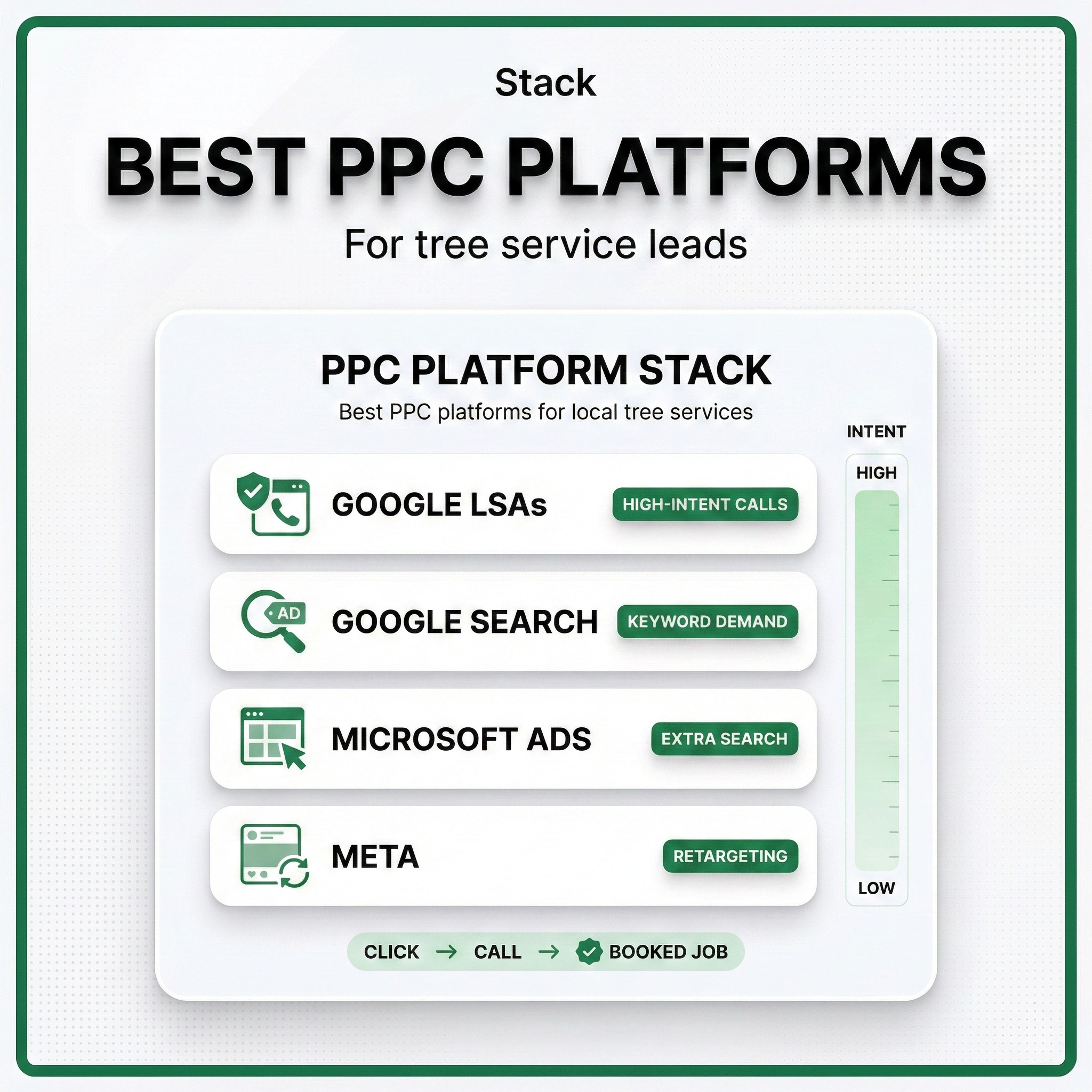
For local tree service PPC in 2026, the strongest performers are usually Google Local Services Ads and Google Search Ads because they capture high-intent “near me” demand at the moment homeowners are ready to call. Local Services Ads operate on a pay-per-lead model where you pay when customers contact you through the ad, while Google Search Ads let you target searches and locations directly. Microsoft Advertising can be a useful secondary search channel with similar location targeting, and Meta Lead Ads are best used for lead forms and retargeting rather than “I need a tree removal company right now” intent.
Table of contents
- What “best” means for tree service PPC
- The top PPC platforms for local tree service ads
- When to use each platform
- The winning platform stack for most tree companies
- Lead quality controls that prevent wasted spend
- A 7-day setup plan
- FAQs
- SEO bundle and schema
1. What “best” means for tree service PPC
“Best” is not cheapest clicks. For tree services, best usually means:
- More calls and estimate requests from homeowners in your service radius
- Better lead quality (right job types, realistic timelines)
- Booked jobs you can attribute to a channel
So the correct platform depends on whether you need:
- urgent demand (storm damage, emergency removals)
- planned demand (pruning, maintenance, stump grinding)
- commercial contracts (property managers, HOAs)
2. The top PPC platforms for local tree service ads
Platform 1: Google Local Services Ads
Best for: high-intent local leads that want to contact you now.
How it works: your business can appear prominently in Google Search results, and people can call, message, or request booking; you pay when a customer contacts you through the ad.
Why tree companies like it:
- It’s designed around local service demand and direct contact
- It’s closer to “lead buying” than classic PPC
Platform 2: Google Search Ads
Best for: capturing intent keywords such as “tree removal near me,” “stump grinding,” “emergency tree service.”
Google describes search ads as targeting people actively searching for your products/services, and location targeting lets ads appear in geographic areas you select.
Why it works:
- tight control over keywords, geography, and landing pages
- scalable once you find winning services and neighborhoods
Platform 3: Microsoft Advertising (Bing Search)
Best for: incremental search leads beyond Google and sometimes lower competition.
Microsoft’s own guidance covers targeting criteria including location, and its network places search ads across the Microsoft Advertising Network.
Why it can be worth it:
- often underused by local service advertisers
- easiest to run by copying your best Google Search structure and adapting
Platform 4: Meta Ads (Facebook/Instagram)
Best for: lead forms and retargeting, not pure “I need it now” search intent.
Meta’s lead generation objective is explicitly designed to find potential customers and collect leads.
Where it shines for tree services:
- storm season readiness campaigns
- remarketing people who visited your service pages but didn’t call
- neighborhood visibility that supports referrals and brand trust
3. When to use each platform
Use Google Local Services Ads when:
- you want more phone calls and message leads quickly
- you offer emergency work, removals, or high-urgency services
- you can respond fast (speed-to-lead is a dealbreaker)
Google’s help documentation states you’re charged for each valid lead received through Local Services Ads.
Use Google Search Ads when:
- you want control over keywords and service-specific campaigns
- you want to push high-value services (removal, crane work, commercial, stump grinding)
- you can build intent-matched landing pages
Use Microsoft Advertising when:
- you already have Google Search working and want incremental volume
- your market has enough search demand to justify a second engine
- you want to diversify without changing your core offer
Use Meta Lead Ads when:
- you can qualify leads (service type, location, timeline) inside the form
- you have a follow-up system (calls within minutes, not hours)
- you want retargeting to raise close rate
4. The winning platform stack for most tree companies
If you want a practical default stack:
- Google Local Services Ads for direct lead capture
- Google Search Ads for scalable, keyword-driven demand
- Meta retargeting / lead forms to recover undecided homeowners
Optional: Microsoft Advertising for additional search volume
5. Lead quality controls that prevent wasted spend
Most PPC waste in tree services comes from unqualified inquiries.
Put these controls in place:
- Service area radius targeting (tight, not “whole city”)
- Separate campaigns by service (removal vs trimming vs stump)
- A short lead form that asks:
- service needed
- address/neighborhood
- timeline
- photos (optional but powerful)
- service needed
If you cannot qualify, your “cost per lead” will look fine while your booked jobs stay flat.
6. A 7-day setup plan
Day 1: Choose your stack
Start with either:
- LSAs + Google Search, or
- Google Search only (if LSAs aren’t available in your area/category)
Day 2: Build service-specific landing pages
One page per core intent:
- removal
- trimming
- stump grinding
- emergency
Day 3: Implement call and form tracking
Track calls and form submissions by channel.
Day 4: Launch Google Search
Start with tight location targeting and exact service keywords.
Day 5: Launch LSAs (if eligible)
Complete profile, service areas, and hours.
Day 6: Add retargeting
Retarget site visitors and video engagers with proof and a clear call-to-action.
Day 7: Review and tighten
Cut:
- broad keywords
- out-of-area leads
- job types you don’t want
Double down on:
- the services that book fastest
- the areas with the best close rate
FAQs
What is the best PPC platform for emergency tree service?
Google Local Services Ads and Google Search Ads are typically strongest because they capture urgent search intent and direct contact.
Do Local Services Ads charge per click?
No. Google explains you’re charged for each valid lead you receive through your Local Services ad.
Should I run Facebook ads for tree removal leads?
Sometimes, but they tend to work better for lead forms and retargeting. Meta’s lead objective is built for capturing potential customer details.
Is Bing worth running for local tree service ads?
It can be, especially as a secondary channel. Microsoft Advertising supports location targeting criteria and distributes ads across its network.
What matters more than platform choice?
Response speed, service-page conversion, and lead qualification.