
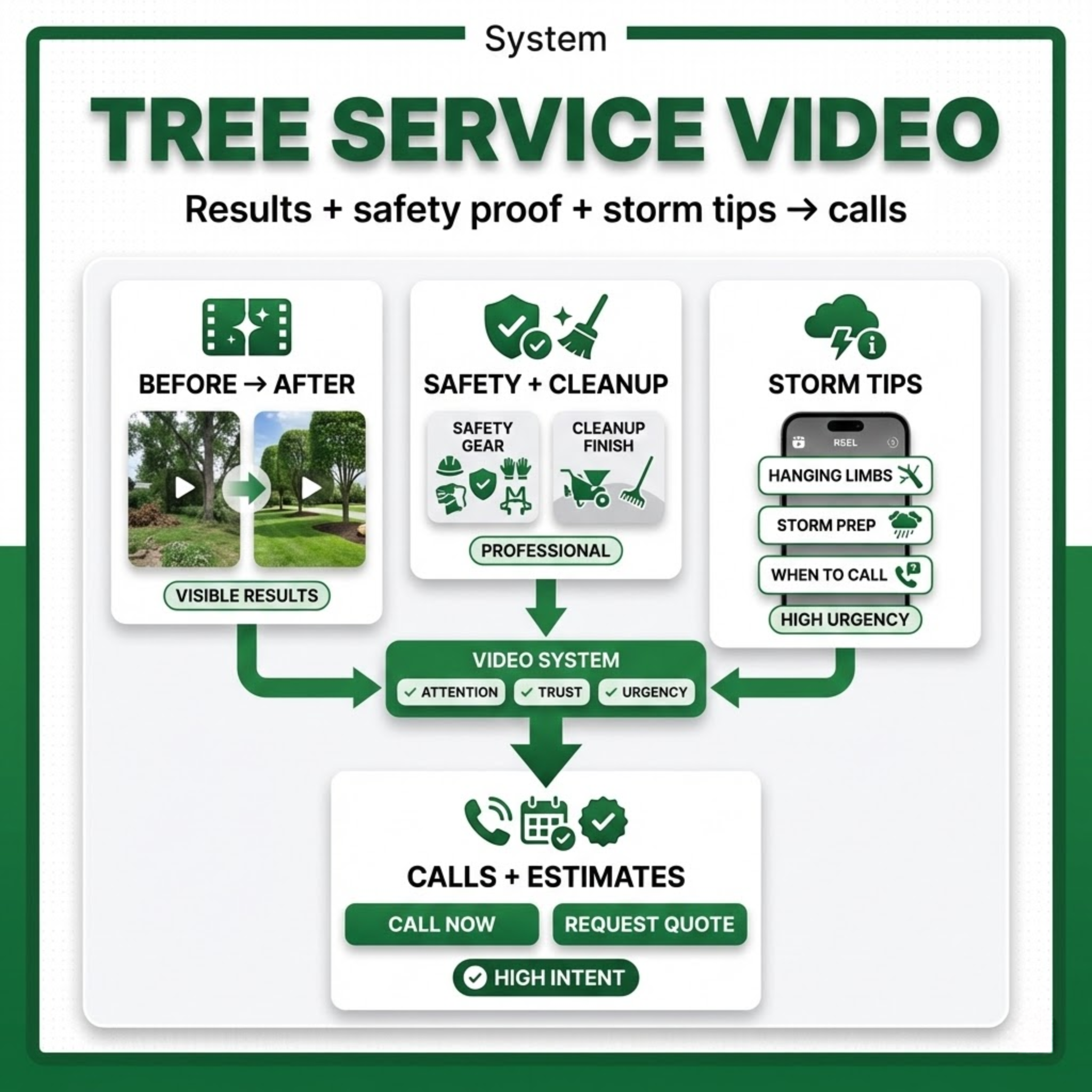
The best video marketing for tree services is proof-driven and local: short before-and-after clips, safety and cleanup demonstrations, storm-response guidance, and customer testimonial videos that make homeowners feel confident to call. In 2026, you win by building a repeatable video system that feeds Google Business Profile, social platforms, and your service pages, then tracking which videos lead to calls and estimate requests.
Table of contents
- What video has to achieve for tree service leads
- The 8 video types that consistently generate inquiries
- Where to publish videos for maximum local impact
- How to structure videos so they convert
- A simple filming setup that still looks professional
- Editing rules that increase trust
- How to turn one job into a month of content
- A 30-day video marketing plan
- FAQs
- SEO bundle and schema
1. What video has to achieve for tree service leads
Video is not entertainment for service businesses. It is trust compression.
A good tree service video does three things fast:
- shows the problem clearly
- shows your process and safety approach
- shows the finished result and cleanup
If any one of those is missing, your video can get views but not calls.
Video should also pre-qualify leads:
- show the scale of work you handle
- show equipment capability
- set expectations about cleanup, access, and timeline
That reduces time-wasters and increases close rate.
2. The 8 video types that consistently generate inquiries
If you only make “cool cutting videos,” you will attract spectators. If you make these formats, you attract buyers.
1) Before-and-after with a clear voiceover
This is the highest-performing format for most tree companies.
Structure:
- 3 seconds: show the hazard or reason for work
- 10 seconds: explain the plan and safety
- 5 seconds: show the result and cleanup
CTA:
“Call for an estimate” or “Send a photo for a quick assessment.”
2) “What we found” hazard explanation
Homeowners often do not understand why a tree is dangerous.
Examples:
- deadwood over a roofline
- trunk rot
- weak unions
- root plate lift after storms
These videos create urgency and authority without being salesy.
3) Cleanup proof videos
Cleanup is a conversion trigger.
Film:
- tarp protection
- driveway blown off
- lawn raked
- final walkthrough
A 15-second cleanup proof clip can generate more leads than a “big crane” clip because it removes fear.
4) Safety process micro-videos
People assume tree work is risky. Show your controls.
Examples:
- PPE checks
- rigging setups
- drop zone planning
- traffic control around roads
Keep it calm and professional. Avoid bravado.
5) Customer testimonial clips
Short is better.
Prompt them:
“What made you choose us?”
“What was your biggest concern?”
“How did the cleanup and communication feel?”
You want language about trust and reliability.
6) Storm response and emergency guidance
This builds local authority and gets shared in community groups.
Examples:
- “What to do if a tree falls on your fence”
- “When to call vs when to wait”
- “How to document damage for insurance”
These videos also funnel into emergency calls.
7) “Price drivers” education without numbers
You can explain what affects scope without quoting.
Examples:
- access difficulty
- proximity to structures
- disposal needs
- crane requirements
This reduces sticker shock and raises lead quality.
8) Commercial capability videos
If you want commercial contracts, show:
- multi-site maintenance workflow
- documentation and reporting
- safety compliance coordination
- scheduling systems
Commercial buyers respond to process visibility.
3. Where to publish videos for maximum local impact
A tree service video strategy should not rely on one platform.
Google Business Profile
Post short videos and job updates. This supports trust in local decisions.
Your website service pages
Embed the most relevant videos on:
- tree removal page
- trimming/pruning page
- emergency service page
- stump grinding page
This increases conversion because homeowners see proof at decision time.
Facebook and Instagram
Use Reels and short posts for neighborhood reach.
Best use:
- before/after
- storm readiness
- testimonials
Nextdoor (where active)
Post practical safety guidance and job proof. Nextdoor pairs well with referrals and community trust.
YouTube (optional but powerful)
YouTube is best as a library:
- “Tree Removal 101”
- “Emergency Tree Service Guide”
- “How to tell if a tree is unsafe”
You do not need weekly long videos. You need a few strong evergreen ones.
4. How to structure videos so they convert
If you want leads, every video needs:
Hook (first 2–3 seconds)
Show the problem:
- tree leaning over a roof
- branches over power lines
- storm damage
- blocked driveway
Proof (middle)
Explain the plan briefly:
- what you’re doing
- how you protect property
- how you ensure cleanup
Result (end)
Show:
- stump area cleared
- lawn intact
- driveway clean
CTA that fits the platform
Examples:
- “Call now for emergency service”
- “Send a photo for a quick assessment”
- “Book an estimate through the link”
The CTA must be one step. Not a menu.
5. A simple filming setup that still looks professional
You do not need a camera crew. You need consistency.
Minimum setup:
- smartphone with good stabilization
- lapel mic for voiceovers or on-site talk
- spare battery pack
- a simple tripod for before/after
Always film in vertical first. Most platforms are vertical-first in 2026.
Safety note: never film while operating equipment. Film before, after, or have a dedicated person film from a safe position.
6. Editing rules that increase trust
Over-editing can reduce credibility.
Rules:
- keep clips short and honest
- avoid dramatic music that makes it feel like a stunt show
- include at least one “wide shot” so scale is clear
- always show cleanup and the finished property
Add captions. Many people watch without sound.
7. How to turn one job into a month of content
One job can produce 8–12 pieces of content.
Capture:
- before: hazard close-up + wide shot
- process: rigging setup + property protection
- result: stump area + cleaned driveway
- explanation: a short “what we did and why”
- testimonial: 10 seconds if customer agrees
Now you have:
- one main video
- multiple micro-clips
- still frames for posts
- website assets for service pages
8. A 30-day video marketing plan
Week 1: Build the content system
- Create 4 templates: before/after, cleanup proof, safety process, storm tip
- Decide your posting rhythm: 3 short videos per week
Week 2: Capture proof
- Film 3 jobs using the same structure
- Collect 1 testimonial clip
Week 3: Publish strategically
- Post videos to Google Business Profile and social
- Embed the best ones on the matching service pages
Week 4: Track and refine
- Track calls and form submissions after posts
- Double down on the formats that lead to estimates booked
FAQs
Do videos actually help tree service leads?
Yes, when they show proof, safety, and cleanup. Views alone do not matter. Calls and estimate requests matter.
Should I post long videos or short videos?
Short videos are usually best for lead generation. Long videos work as evergreen education on YouTube.
What should I avoid filming?
Avoid filming anything unsafe, reckless, or that looks like showboating. It can reduce trust.
How often should I post?
A sustainable rhythm beats bursts. Three short videos per week is enough for most businesses.
What video gets the most calls?
Before-and-after plus cleanup proof is the most consistent “lead” format for tree services.
Do I need to show prices?
No. Focus on scope drivers and process. Pricing is usually site-specific.