
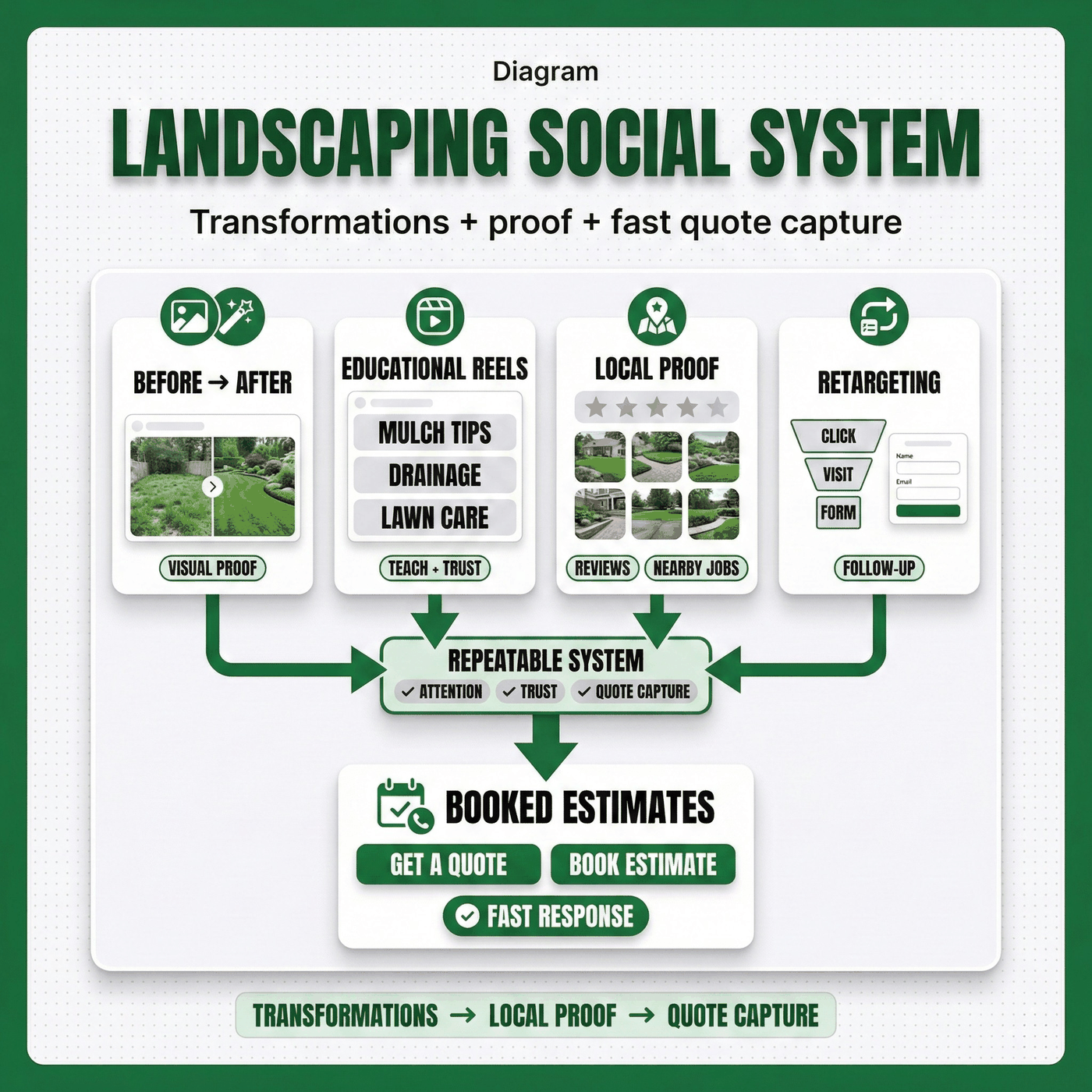
The most effective social media strategies for landscaping companies are a repeatable content system built around visible transformations, local proof, and fast lead capture. That means posting before-and-after work consistently, using short educational content that answers homeowner questions, and running simple retargeting and lead-form ads for people inside your service area. Some industry marketing roundups report that before-and-after visuals correlate with higher conversion outcomes, and social media experiences can influence recommendations, which is exactly how landscaping referrals spread.
Table of contents
- What “effective” means for landscaping social media
- The content pillars that produce real enquiries
- The posting cadence that keeps you visible without burning out
- The creative formats that perform best right now
- Local targeting that attracts homeowners, not followers
- Turning social attention into booked estimates
- Retargeting: the simplest way to improve lead quality
- A 14-day launch plan
- FAQs
1. What “effective” means for landscaping social media
A landscaping company does not need virality. It needs:
- Local homeowners who can afford the work
- Proof that reduces uncertainty
- A frictionless path to request a quote
Success is not likes. Success is:
- Quote requests
- Calls
- Booked site visits
- Jobs sold
If you do not track those outcomes, social media becomes a time drain.
2. The content pillars that produce real enquiries
You need a small set of repeatable post types that build trust and prompt action.
Pillar A: Transformations (before and after)
This is the highest leverage category for landscaping because it shows value instantly.
What to post:
- Before and after from the same angle
- A quick 3-point breakdown: problem, solution, result
- A “scope marker” so homeowners self-qualify (size of yard, timeline, service included)
Some landscaping marketing statistics roundups specifically highlight the conversion impact of before-and-after visuals in this category.
Pillar B: Proof and credibility
Homeowners want to feel safe choosing you.
What to post:
- Customer reviews on screen
- Crew and equipment in action
- Cleanup and finishing details
- Short “what we included” captions to set expectations
Pillar C: Education that sells without sounding like selling
Your best educational posts answer the questions people ask right before hiring.
Topics that convert:
- “How often should you mow in summer?”
- “When is the right time to prune?”
- “How to stop weeds without killing your lawn”
- “What to expect from a seasonal cleanup”
There is also broader social media research suggesting people value useful content over purely promotional posts, which aligns with what performs in practice for home services.
Pillar D: Local and seasonal triggers
Landscaping is seasonal. Use that.
Examples:
- First spring cleanup window
- Pre-holiday curb appeal
- “Rainy season” growth and weeds
- Heat stress and irrigation reminders
3. The posting cadence that keeps you visible without burning out
A realistic cadence for a small landscaping team:
- 3 posts per week (proof, education, transformation)
- 5–10 stories per week (quick job clips, progress shots)
- 1 community post per week (local tips, neighborhood engagement)
Consistency beats volume. You are training your local audience to remember you when the yard becomes a problem.
4. The creative formats that perform best right now
Do not overcomplicate production. Use formats that naturally suit landscaping.
Short video (Reels)
- 6–12 seconds: reveal the “after”
- 15–25 seconds: quick walkthrough with 3 steps
- Caption always includes service area and next step
Carousels (Instagram and LinkedIn)
Carousels have been reported to deliver strong engagement performance in platform-level analyses, which is useful for explaining transformations step-by-step.
Static before-and-after
Still works because it is instantly legible.
5. Local targeting that attracts homeowners, not followers
A landscaping account can look “successful” and still produce zero leads if the audience is wrong.
Rules:
- Tag the city and neighborhood where the job happened
- Use local hashtags lightly (5–8, not 30)
- Post in local Facebook groups where allowed
- Encourage reviews and user photos (with permission)
This is how you build local relevance instead of generic visibility.
6. Turning social attention into booked estimates
Your profile needs to function like a landing page.
Minimum setup:
- One clear line: what you do and where you serve
- A single “Request an Estimate” link
- A pinned post explaining: services, service area, how quotes work
- A highlight folder: Before/After, Reviews, Services, FAQs
For lead capture, Meta supports lead ads designed to collect customer information directly, and their own help guidance lists best practices for setting them up.
7. Retargeting: the simplest way to improve lead quality
The highest quality social leads are often retargeted leads, not cold leads.
Retargeting audiences:
- People who watched 50 percent of a video
- People who engaged with your profile
- People who visited your website
Retargeting works because people see proof multiple times before they decide to invite you to their home.
8. A 14-day launch plan
Days 1–2: Build the foundation
- Update bio, services, service area, estimate link
- Create highlights: Reviews, Before/After, Services
Days 3–7: Publish your proof
- 2 before/after posts
- 2 short videos showing process
- 1 educational carousel
Days 8–14: Add lead capture
- Launch a simple lead form ad for your service area
- Add 3 qualifying questions (service needed, location, timeline)
- Set follow-up: respond within 10–30 minutes during business hours
If you do only one improvement, improve response time. Social leads go cold quickly.
FAQs
Which social platform is best for landscaping?
Instagram and Facebook usually work well because visuals matter and local community reach is strong. Nextdoor can also be powerful for neighborhood trust, depending on your market.
How often should a landscaping company post?
A consistent 3 times per week is enough to stay visible if each post is proof-driven and local.
What type of posts get the most landscaping leads?
Before-and-after transformations, review-based proof, and short educational videos that answer hiring questions.
Should I run ads or only post organically?
Organic builds trust and local authority. Ads accelerate lead flow. The strongest approach uses both.
How do I stop getting price shoppers?
Show scope clearly, show proof, and qualify leads with location and service questions before you quote.
Do lead forms work?
They can, especially with fast follow-up and simple qualification. Meta’s own guidance is to keep lead ads optimized and follow up efficiently.