The most reliable way to earn five-star reviews for tree removal is not asking harder. It is engineering the job experience so customers feel safe, informed, and respected, then requesting the review at the exact moment satisfaction peaks, with a frictionless link and a simple prompt. You cannot incentivize reviews or pressure customers, but you can make reviewing easy and consistent.
Table of contents
- What actually creates five-star reviews in tree removal
- The review system: timing, channel, and scripting
- How to increase review volume without breaking platform rules
- How to handle “almost five-star” situations before they become public
- Review prompts that produce useful review content
- Responding to reviews to increase trust and local leads
- A 14-day implementation plan
- FAQs
- SEO bundle and schema
1. What actually creates five-star reviews in tree removal
Tree removal is a high-risk, high-emotion service. Homeowners are anxious about:
- damage to roofs, gutters, paving, gardens, and cars
- safety and professionalism
- mess and debris
- whether the team will communicate and show up on time
Most five-star reviews come from customers feeling two things:
- “They took control and I felt safe.”
- “They left my property cleaner than I expected.”
So your “five-star strategy” begins with experience design:
The five-star experience checklist
Before arrival
- Confirm arrival window by text
- Ask for gate/access details
- Tell them what you’ll protect (driveway, lawn, roofline)
- Set cleanup expectations clearly
On arrival
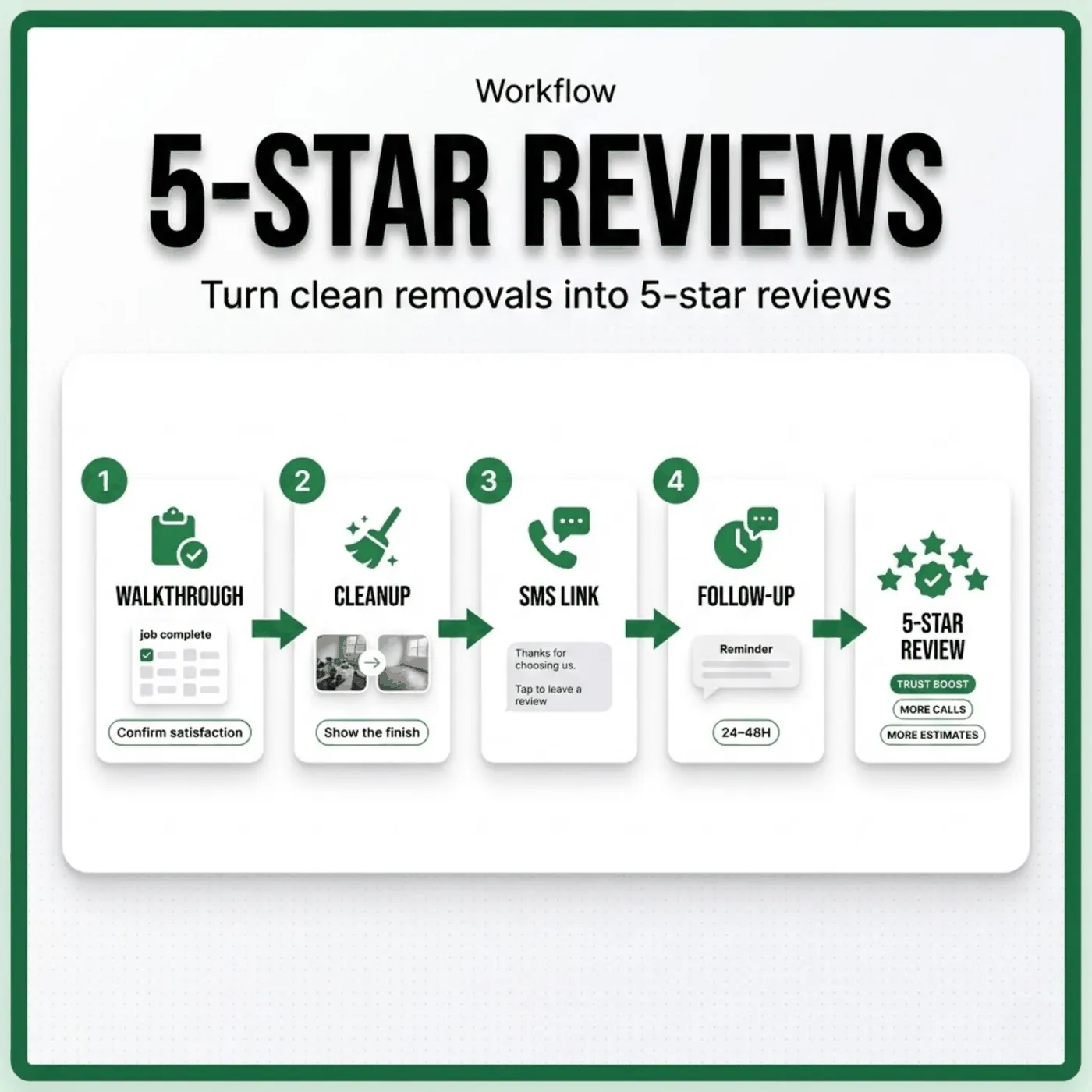
- Walk the property with the customer (2–5 minutes)
- Confirm what is included and excluded
- Point out the drop zone and protection plan
During the job
- Keep noise and disruption respectful
- Do not let workers argue or appear unsafe
- If you need to change scope, communicate immediately
After the job
- Final walkthrough with the customer
- Show them the cleanup standard
- Confirm they are satisfied before leaving
If you do only one upgrade: always do the final walkthrough. That is where five-star reviews are made.
2. The review system: timing, channel, and scripting
A review system has three parts:
- when you ask
- how you ask
- how easy you make it
Best time to ask
Ask when satisfaction is highest:
- immediately after the walkthrough
- within 30 minutes of leaving
- or the same evening
Asking days later usually reduces response rate and increases the odds of forgotten details.
Best channel
For most tree removal customers:
- SMS works best (fast, low effort)
- email works as backup
- WhatsApp can work in some regions where it’s the default communication channel
The two-message approach that works
Message 1: immediate
- gratitude
- direct review link
- one sentence about what to mention
Message 2: a single follow-up
Send 48–72 hours later if they haven’t reviewed.
Do not nag. One follow-up is enough.
Script templates (copy/paste)
Use these exactly as written or adapt them.
SMS after walkthrough
“Thanks again for having us out today. If you have 30 seconds, would you leave a quick review here? [link] It really helps local homeowners choose a safe, reliable crew. If you mention the cleanup and how the job went, it helps others.”
Follow-up
“Quick follow-up in case you missed this. If you were happy with the work, a short review here makes a big difference for us: [link]. Thank you.”
These scripts work because they:
- respect time
- explain why the review matters
- make the customer feel helpful, not used
3. How to increase review volume without breaking platform rules
You want five-star reviews, but you also want to stay compliant.
What you should not do:
- offer discounts, gifts, or money for reviews
- “gate” reviews by only asking happy customers (ask everyone)
- pressure customers to leave only five stars
A safe rule:
Ask every customer, every time, with the same process.
That consistency increases volume and protects you from policy issues.
Make it easy with a review link
Have one short link that the office and crew can send instantly.
Also add:
- a QR code on the invoice
- a “Review us” button in your email signature
- a simple printed card the crew can leave
4. How to handle “almost five-star” situations before they become public
Most negative reviews happen when the customer feels ignored after a problem.
You can prevent that by adding one step to your closeout:
The satisfaction checkpoint question
At the end of the walkthrough ask:
“Is there anything you’d like us to fix or clean up further before we go?”
This gives the customer a safe way to express dissatisfaction privately.
The recovery rule
If something went wrong:
- fix it fast
- communicate clearly
- follow up after the fix
A recovered customer often leaves a stronger review than a normal one because they feel taken care of.
5. Review prompts that produce useful review content
Reviews that convert leads mention specifics.
You cannot tell customers what to write, but you can prompt them with a menu:
“People usually mention what mattered most, like: safety, communication, cleanup, or punctuality.”
This often produces reviews that include the exact trust signals future customers look for.
Best “five-star trigger topics” for tree removal:
- “They protected my driveway/roof/garden”
- “They cleaned everything”
- “They explained the plan”
- “They were professional and safe”
- “They showed up on time”
6. Responding to reviews to increase trust and local leads
Your replies matter because homeowners read them.
How to reply to five-star reviews
- thank them by name
- reference the job type (tree removal, storm cleanup)
- reinforce the trust values: safety, cleanup, communication
- keep it short
Example:
“Thanks, Sarah. We appreciate the review. We’re glad the removal and cleanup went smoothly and that you felt informed throughout the process.”
How to reply to negative reviews
- stay calm
- acknowledge the experience
- offer a resolution path
- do not argue publicly
Example:
“Thanks for the feedback. We’re sorry the experience didn’t match expectations. We’d like to make this right. Please contact us at [phone/email] so we can resolve this directly.”
Even if the reviewer never replies, future customers see professionalism.
7. A 14-day implementation plan
Days 1–2: Build your review assets
- create a single review link
- create a QR code
- create a short “review request” card template
Days 3–5: Train your closeout process
- add the walkthrough
- add the satisfaction checkpoint question
- standardize cleanup expectations
Days 6–7: Implement review requests
- send SMS immediately after each job
- send one follow-up after 48–72 hours
Days 8–14: Track and tune
Track:
- reviews requested
- reviews received
- average rating
- keywords mentioned in reviews (cleanup, safety, communication)
If your response rate is low, the problem is usually timing or friction, not the script.
FAQs
How many reviews do I need to look credible?
Enough that a homeowner sees recent activity and proof. Recency often matters more than total count.
Should I ask only customers who seem happy?
No. Ask everyone consistently. Do not “gate” reviews.
Can I offer a discount for leaving a review?
No. Do not incentivize reviews. It can violate platform policies and risk your profile.
What if a customer threatens a bad review?
Do not panic. Focus on resolution. Fix what you can, document it, and communicate professionally.
Does asking in person help?
Yes. The best moment is right after the final walkthrough when they can see the result.
What is the biggest reason customers don’t leave reviews?
They forget. That’s why the immediate link and one follow-up matter.